
Embracing Slow Living as a Mom: Decluttering Your Schedule and Your Home
Tired of the constant hustle? Discover how embracing slow living can help you declutter your…

Bible journaling is simply your personal, creative response to Scripture. You can do it right in the margins of your Bible or in a separate notebook. It’s a beautiful way to blend worship, study, and art, helping God’s word sink in and stick with you—even if you only have five minutes.

I get it. As a mom, starting anything new can feel like one more item on an already overflowing to-do list. But here’s the secret to Bible journaling: it’s incredibly flexible. This isn’t about becoming a professional artist overnight. It’s about carving out a small, quiet space to connect with God amidst the beautiful chaos of motherhood.
Forget needing an hour of uninterrupted silence—that’s a rare gift in this season of life! Many moms I know find their sweet spot during a toddler’s nap, before the kids wake up, or even while waiting in the carpool line. The whole point is to build a habit that serves you, not one that stresses you out.
So, how do you actually start Bible journaling? It’s much simpler than you might think. Don’t worry about having all the “right” things. Just focus on these three small things to get going today.
This stripped-down approach makes it so much more doable. It’s a quiet moment to reflect and meditate on His truth in a way that truly sticks. It’s no wonder the practice has become so popular. In fact, people are actively looking for ways to combine deep study with personal reflection. Search data actually shows that people look for ‘Bible study journal’ far more often than ‘Christian prayer journal’, which tells me there’s a real hunger for engaging with Scripture on a deeper level. You can see more of these Bible journal trends on Accio.com.
The goal of Bible journaling isn’t to create a perfect masterpiece for Instagram. It’s to create a personal, visual record of your walk with God—a keepsake of His faithfulness through every season.
Starting with these tiny, manageable steps makes all the difference. This is a journey of progress, not perfection. It’s about finding joy in the simple, quiet act of creating and worshipping.
For anyone feeling overwhelmed, here’s a quick-start plan to keep things simple and focused.
| Focus Area | What You Need | Time Commitment |
|---|---|---|
| Space | A small basket or corner where your supplies can live. | 1 minute to set up initially. |
| Tools | A journaling Bible or notebook and one good pen. | 30 seconds to grab what you need. |
| Scripture | Choose just one verse that speaks to you. | 1 minute to read and select. |
| Action | Write the verse and one thought about it. | 2-3 minutes to journal. |
This simple framework proves that you really can connect with God’s word meaningfully in just 5 minutes. It’s all about starting small and letting the habit grow naturally from there.
Let’s bust one of the biggest myths about Bible journaling right now: you do not need a mountain of expensive, fancy art supplies to start. I promise. Creating a meaningful entry in your Bible has everything to do with your heart and very little to do with your budget.
Honestly, you can get started with things you already have sitting around the house. I know so many moms who discovered their favorite tools by “shopping” their own drawers first. Grab that pack of colored pencils the kids use for school—they’re perfect. The highlighters in your desk? They can create a beautiful, soft wash of color right on the page.
When you feel ready to buy a few dedicated items, just focus on the basics that will give you the most creative bang for your buck. The main goal is finding affordable tools that won’t bleed through or damage those delicate Bible pages.
Here’s one of my all-time favorite budget hacks: use a regular highlighter as a stand-in for watercolor paint. Just scribble some of the highlighter onto a plastic sandwich bag, spray a tiny bit of water on it, and then use a small paintbrush (or even a Q-tip!) to lift the color and paint it onto your page. It works like a charm!
Adding those little personal touches is so much fun, and this is where you can really get creative without spending much at all. Think of the dollar store as your new best friend! You can often find washi tape, cute stickers, and patterned paper for way less than you’d pay at a craft store.
You can also find tons of free printable scripture art and journaling templates online. A quick search on Pinterest will bring up hundreds of beautiful designs. You can print them on regular paper or clear sticker paper for custom-made embellishments that only cost pennies.
Remember, starting your Bible journaling journey is about connecting with God’s Word, not about collecting supplies. Start small, use what you have, and never forget that your worship is the most beautiful thing on the page.
Let’s be honest, mama. The real trick to a meaningful Bible journaling habit isn’t about suddenly finding a magical, kid-free hour in your day. It’s about weaving these creative moments of worship into the life you’re already living. If you try to tack it on as just another “to-do,” it’s bound to feel like a burden.
The secret I’ve found is to “habit stack”—that is, connect your new journaling time to something you already do every single day without thinking. For example, do you have a morning coffee routine that’s non-negotiable? Perfect. The night before, set your journaling Bible and a favorite pen right next to your coffee maker. Just seeing it there removes half the battle and ties your quiet time to a comforting ritual you already love.
Your ideal journaling slot probably won’t look like anyone else’s, and it definitely doesn’t have to be at 5 a.m. The key is to get creative and claim those little pockets of peace that pop up throughout your day.
Maybe your time is…
You’re not alone in wanting this deeper connection. There’s a real hunger for engaging with Scripture in a more personal way. In fact, some reports show a huge 29% jump in Bible use among Millennials in a single year. You can read more about these encouraging trends in Bible reading on Faithwire.com.
Life with little ones is gloriously unpredictable. Some days, your routine will flow beautifully. Other days, it will feel like a complete train wreck. Please, give yourself grace. The goal isn’t a perfect attendance record; it’s a persistent heart that keeps returning to God’s Word.
Consistency over perfection is the absolute golden rule here. So you missed a day? Or a week? It’s okay. Don’t let guilt derail you. The beauty of this spiritual practice is its incredible flexibility.
Sometimes, all you’ll have time for is writing a single word or drawing a simple heart next to a verse that spoke to you. Guess what? That is a victory. It’s about the heart posture, not the time spent. When you start seeing this as a form of biblical self-care for moms, the whole thing shifts from an obligation to a life-giving gift you give yourself.
And don’t forget to celebrate the small wins! Did you manage to journal three times this week amidst the chaos? That’s amazing! Acknowledging your effort, no matter how small it seems, builds the momentum you need to keep going. This simple, grace-filled habit can truly become a powerful anchor in the beautiful, wild sea of motherhood.
That first blank page can feel a little intimidating, can’t it? I know the feeling. You stare at all that empty space, and suddenly, the pressure is on to create something profound. But here’s a secret I’ve learned over years of doing this: creating a meaningful entry isn’t about being an artist. It’s about breaking down your quiet time with God into a few simple, repeatable actions.
I like to think of it as a four-part rhythm: grounding yourself in Scripture, writing out the words, adding a touch of your own creative expression, and then taking a moment to reflect on what God has shown you. This simple flow is what transforms a blank page into a personal space of worship.
This visual guide breaks down a simple journaling routine into three core parts: finding your time slot, connecting with your supplies and Scripture, and celebrating your progress.

As you can see, a successful routine is less about finding huge, uninterrupted blocks of time and more about creating small, consistent touchpoints with God’s word throughout your busy week.
Everything starts with God’s Word. So, before you do anything else, choose a verse that’s been on your heart. Maybe it’s something from a recent sermon, a line from a devotional you’re reading, or a familiar Psalm you always turn to for comfort. Read it slowly. Let the words really sink in.
Now, let’s get those words onto the page. You absolutely do not need to be a calligraphy expert for this part! One of the easiest and most meaningful methods is simply to trace the verse. Just write it out on a scrap piece of paper in your own handwriting, slide it under your Bible page (most are thin enough to see through), and gently trace over it. The physical act of writing out the words is a powerful way to help cement them in your memory and heart.
My favorite shortcut when I’m short on time is to use alphabet stamps. I can quickly stamp a key word from the verse, like “Hope” or “Peace,” and then write the rest of the verse around it. It adds a beautiful visual element in seconds and feels special without a lot of effort.
Okay, now for the fun part: adding a splash of your own creative touch. Remember, the art in your Bible journal is not a performance; it’s an act of worship. Even the simplest doodle can be a beautiful expression of praise.
Here are a few incredibly simple ideas to get you started:
To help you visualize some options, here’s a quick look at a few techniques that are perfect for when you’re just starting out.
| Technique | Supplies Needed | Beginner Friendliness |
|---|---|---|
| Highlighting | Bible-safe highlighters or gel pens | ★★★★★ (Extremely Easy) |
| Washi Tape | Decorative paper tape | ★★★★★ (Extremely Easy) |
| Stickers | Themed sticker sheets or books | ★★★★★ (Extremely Easy) |
| Stamping | Alphabet or icon stamps, ink pad | ★★★★☆ (Very Easy) |
| Colored Pencils | A small set of colored pencils | ★★★★☆ (Very Easy) |
| Watercolor Pencils | Watercolor pencils, water brush | ★★★☆☆ (Easy, with a little practice) |
As you can see, you don’t need to be an expert to add beautiful touches to your pages. Start with what feels most approachable to you!
Finally, always close your time with reflection. Honestly, this is the most important step. In a small corner of the page, or even just in your heart, offer a short prayer. You could write a single sentence about what the verse means to you today, or jot down a question you want to ask God. This final step is what turns a creative exercise into a true, life-giving conversation with your Creator.
https://www.youtube.com/embed/DKwSrMYt15g
Let’s be real—some days, the inspiration just isn’t there. You finally sit down with your Bible, and your mind is a complete blank, buzzing with the day’s to-do list instead of holy thoughts. This is exactly when having a few go-to prompts and simple layouts can be an absolute lifesaver.
Think of them as simple entry points to get your creative and spiritual juices flowing. Instead of staring at a blank page, you can jump right into a meaningful reflection, even if you only have five minutes before the laundry buzzer goes off. A good prompt gives you a theme to meditate on, turning that moment of “what do I even write?” into focused worship.
When you need a gentle nudge, just turn to one of these themes. Find a verse that speaks to that topic and let it guide your quiet time. This practice of tying what’s on your heart directly to Scripture is such a powerful way to renew your mind.
Having a list of go-to prompts is like having a spiritual first-aid kit. When your heart feels weary or your mind is distracted, you have an immediate tool to reconnect with God’s truth and find your footing again.
A simple structure can make all the difference when you’re squeezed for time. These quick layouts help organize your thoughts visually, making it easy to create a beautiful and meaningful entry in just minutes. They’re perfect for that little pocket of time during a homeschool lesson or while you’re waiting for dinner to come out of the oven.
One of my personal favorites is the two-column layout. It’s so simple. On the left side of the page, write out your chosen scripture. On the right, jot down a few bullet points about how that verse applies to your life right this very second. It’s clean, simple, and surprisingly effective.
Another great option is the three-block layout. Just divide your page into three small sections for:
Using simple layouts like these, combined with positive self-talk, can completely shift your mindset. For more ideas on nurturing a positive heart, you might find these affirmations for moms really encouraging. Keeping your journaling practice fresh is the key to making sure it remains a life-giving habit, not another chore.
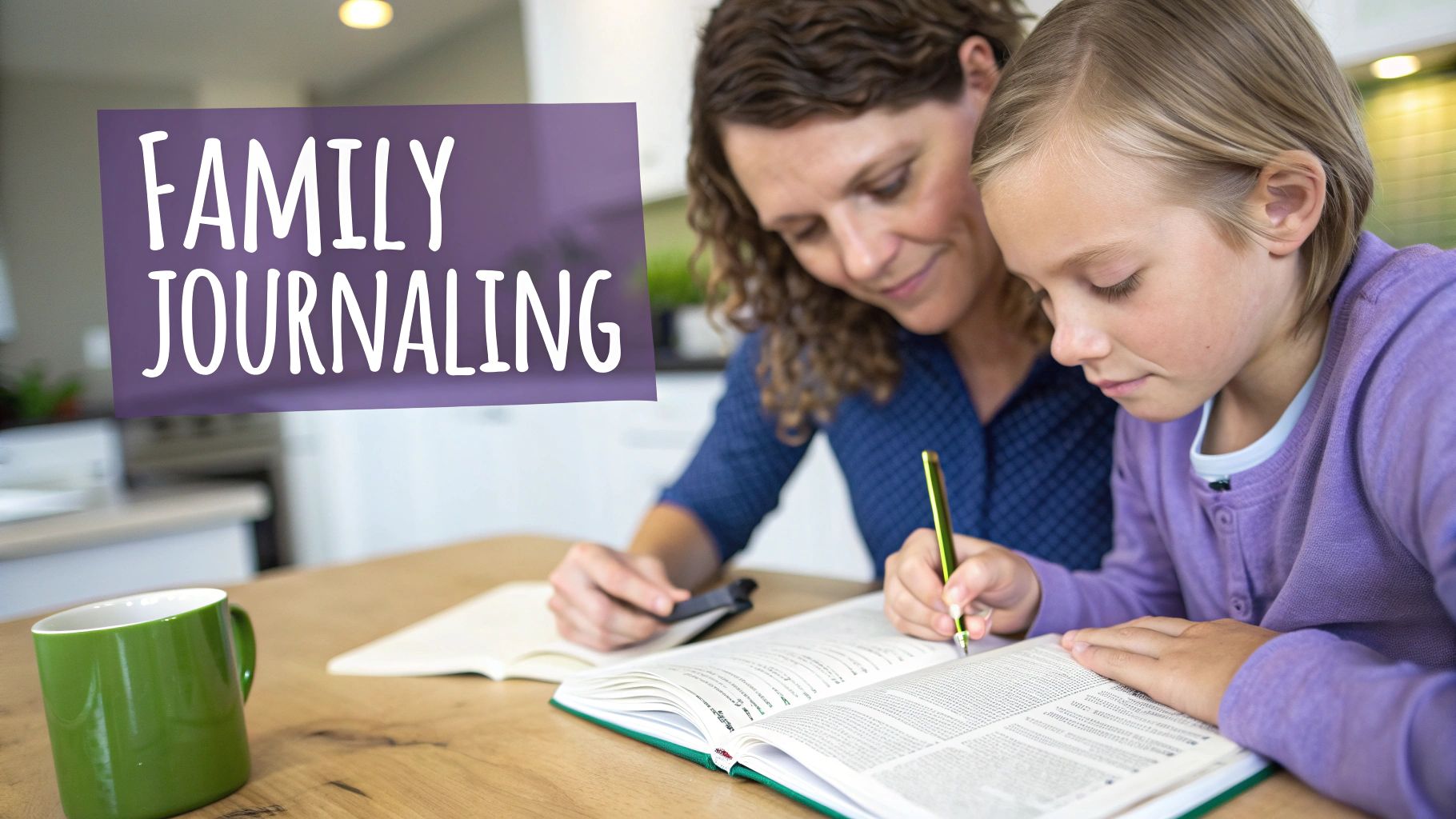
Bible journaling doesn’t have to be something you only do alone in the quiet moments before the house wakes up. In fact, inviting your family into the process can transform your personal quiet time into one of the most beautiful ways to nurture everyone’s faith. It turns a personal act of worship into a shared, memory-making experience.
I’ve seen so many homeschooling moms use journaling to spark surprisingly deep conversations about Scripture. Instead of just reading a story, you can invite your kids to draw their favorite part, which often opens up a whole new level of understanding and connection for them.
The trick is to keep it simple and fun. Let go of any ideas about perfection. Your only goal is to create a positive, pressure-free space where your kids feel excited to spend time in God’s Word. It’s all about the process, not the final product.
For little ones, this could look like:
For older kids and teens, you could try creating a collaborative journal page. One person can write out the memory verse for the week while another illustrates it. This sense of shared ownership creates a beautiful family keepsake and a powerful teaching tool. For more wonderful ideas, check out our guide on how to teach your kids about faith.
I love turning our weekly memory verse into a family art project. We lay out a big piece of paper, and everyone gets to contribute. My son might draw a picture, my daughter will do the lettering, and I’ll add a washi tape border. It hangs on our fridge all week as a constant, colorful reminder of His truth.
This idea of shared creative time is becoming more and more important as families look for new ways to engage with their faith. In many cultures, discussing Scripture together is a natural part of daily life, making family journaling a perfect fit. And as more New Testament translations become available—with projections nearing 4,400 languages by 2050—even more families will get the chance to dive into God’s Word together in their own language.
By inviting your children into this practice, you’re doing so much more than just making art. You’re building a foundation of faith, one colorful page at a time.
It’s completely normal to have a few questions when you’re starting something new. Let’s tackle some of the most common worries I hear from moms just like you, so you can dive in with a heart full of confidence instead of hesitation.
I hear this one all the time, and I want to put your mind at ease. Please, take this to heart: Bible journaling is about your heart, not your art. This isn’t about creating a museum-worthy masterpiece; it’s a personal act of worship and a way to connect with God’s Word on a deeper level.
If you can write your name or underline a sentence that speaks to you, you have everything you need to begin. You can start by simply writing out a key verse in your own handwriting. If you want to add some flair without any drawing, tools like stickers, washi tape, and pre-made stencils are your best friend. The real goal is connecting with Scripture, not perfection.
Ah, the dreaded bleed-through! Those delicate Bible pages can be a challenge, but it’s an easy one to solve once you know the secret: choosing the right supplies.
The key is to look for pens with pigment-based or archival ink. My absolute go-to is the Pigma Micron pen, which is famous in the journaling community for not bleeding. On the flip side, you’ll want to stay far away from permanent markers like Sharpies or any other alcohol-based markers.
Before you commit to a page, always do a little test run in an inconspicuous spot, like the index or copyright page at the back of your Bible. A quick pen test can save you a lot of frustration.
My Go-To No-Bleed Tip: When in doubt, colored pencils and Bible-safe gel highlighters are your best friends. They’re fantastic for adding beautiful, soft color to your pages without any risk of bleeding or even “ghosting” (where you can see the color on the reverse side).
Taking a moment to test your tools helps you relax and enjoy the process, keeping your focus right where it belongs: on your time in the Word.
At Motherhood and Homemaking, we’re passionate about helping you weave your faith into every part of your beautiful, busy life. Find more encouragement and practical tips at https://motherhoodandhomemaking.com.
Article created using Outrank

