Gentle Homeschool Curriculum for Kindergarten
A gentle, Christ centered homeschool curriculum for kindergarten is less about rigid academics and more…

Welcome to the gentle art of copywork. If you've ever felt that teaching grammar and handwriting had to involve tedious drills and endless worksheets, I have some wonderful news for you. The Charlotte Mason copywork method is a beautiful, simple, and profound way to teach spelling, grammar, and sentence structure. Think of it as an apprenticeship in great writing, where children learn by immersing themselves in excellent language.
In this guide, you'll discover:
At its heart, the Charlotte Mason approach to copywork is beautifully simple. It's the act of a child carefully transcribing a short, well written passage from a quality source. That’s it.
Imagine an art student sitting in a museum, carefully sketching a masterpiece to understand the artist's technique and form. Copywork is the literary equivalent. Instead of dissecting grammar rules in a vacuum, your child absorbs them naturally by copying beautiful sentences. They begin to internalize the rhythm, vocabulary, and structure of masterful writing, almost by osmosis. This fits perfectly into a Charlotte Mason education, which values short lessons and the power of "living books."
A child’s eye and ear are trained by what they see and hear. When they copy passages from great authors, they are learning the craft of writing from the best teachers.
This isn't about filling pages with repetitive letters. Far from it. The emphasis here is always on quality over quantity. A single, perfectly copied sentence holds far more value than a page of hurried, sloppy work.
Beyond the mechanics of writing, copywork builds habits that will serve a child for their entire life. The focused effort it requires helps cultivate a strong habit of attention. Children learn to notice the smallest details including punctuation, capitalization, and spelling. This fosters a mindset of care and excellence in all their work.
This simple daily practice brings so many benefits to the table:
Ultimately, the copywork Charlotte Mason method is about filling a child’s mind with what is good, true, and beautiful. This means the passages you choose for transcription are just as important as the act of writing itself.
When we give our children passages from classic literature, moving poetry, Scripture, and powerful historical texts, we are handing them a treasury of ideas to ponder. This transforms the lesson from a mere academic exercise into a meaningful encounter with truth. The goal isn't just to produce a good writer, but to nurture a deep love for language and a respect for the power of the written word. It’s a gentle discipline that lays a solid foundation for all future communication, helping your child become a more thoughtful reader and an articulate writer.
To really get to the heart of copywork, we have to look past the what and understand the why. This isn't just some new educational trend; it’s a beautiful, time tested practice rooted in the wisdom of Charlotte Mason herself. She saw this simple act not as a chore, but as one of the first and most vital steps in teaching a child to think clearly and, eventually, express their own ideas with grace.
What she called transcription was so much more than handwriting practice. It was her gentle, yet incredibly effective, way of training a child’s attention and building habits of excellence right from the start.
One of the most brilliant parts of the Charlotte Mason philosophy is her emphasis on short lessons. She knew that a young child's ability to focus is a precious thing, not something to be stretched to its breaking point. Instead of long, drawn out sessions that only lead to tired minds and sloppy work, she championed short bursts of focused, perfect effort.
This idea is absolutely central to copywork. Mason wisely believed it was far better to prevent bad habits from ever forming than to try and fix them down the road. A short lesson, done with a child’s complete attention, ensures that every single letter is formed with care and every punctuation mark is placed just so.
“The child who has been allowed to dawdle at his lessons, to do his work with half a mind, is not on the way to be a person of prompt and decided action.” – Charlotte Mason
This commitment to doing small things well builds a foundation of diligence that spills over into everything else. A child learns to take real pride in their work, understanding that their best effort is what matters, whether the task takes five minutes or an hour. This habit of "perfect execution" becomes a natural part of their character.
For Charlotte Mason, transcription was the bridge between reading beautiful words and writing them. She knew it was the key to developing strong writers without resorting to boring, disconnected drills. By carefully copying well written sentences, a child’s mind naturally absorbs correct spelling, grammar, and sentence structure.
She saw a beautiful, logical progression in learning to write:
The copywork charlotte mason philosophy is built on a deep respect for the child. It assumes they are capable of appreciating beauty and doing excellent work. It feeds their minds with inspiring ideas while simultaneously training their hands to write them down flawlessly.
So, what did this look like in practice? Charlotte Mason, a true pioneer in 19th century British education, made copywork (or "transcription," as she called it) a cornerstone of her writing instruction. She saw it as the primary way for elementary aged children to learn the mechanics of writing by imitating the best.
Her guidelines suggested that children around ages 8 or 9 should spend about 10 to 25 minutes a day on transcription. This time was broken into very short bursts of perfect work, often lasting no more than five to ten minutes at a time. You can learn more about her approach in this elementary writing plan.
When we understand where copywork comes from, we see it’s not just busywork. It’s a profound educational tool that honors a child’s development, builds incredible habits of mind, and lays a beautiful foundation for a lifetime of thoughtful communication. It transforms a simple task into a meaningful part of a rich and living education.
While neat penmanship is often the most visible result of copywork, the real magic is happening under the surface. This simple practice is a powerhouse for nurturing a child's mind in countless ways, building a solid foundation for all their future learning. The benefits truly go far beyond just forming letters correctly.
When a child sits down to do copywork charlotte mason style, they aren't just writing; they're soaking in the very architecture of good language. It’s a gentle, yet profound, way to teach the mechanics of writing in a living, meaningful context, completely removing the need for isolated drills and dry workbooks.
This holistic approach helps a child become not just a better writer, but a more attentive and thoughtful reader and thinker. The careful, focused work builds habits of mind that will serve them for a lifetime.
One of the most powerful things about copywork is how it teaches grammar, punctuation, and spelling organically. Instead of memorizing abstract rules they can’t connect to anything, a child learns by seeing these rules in action within beautiful, well structured sentences.
They see where commas belong, how quotation marks frame a conversation, and which words need a capital letter, all within a compelling story or poem. This method embeds the rules of language into their minds naturally, much like how a child learns to speak by simply listening and imitating.
By engaging with high quality literature, children internalize sophisticated sentence structures, rich vocabulary, and elegant literary styles without ever feeling like they are "studying" grammar.
This process also makes spelling feel intuitive. As a child carefully transcribes a word, they build a visual memory of its correct form. Repeated exposure to properly spelled words in meaningful passages is far more effective and enjoyable than memorizing weekly spelling lists out of context.
Beyond sharpening literacy skills, copywork is an incredible workout for a child's developing brain. The simple act of looking at a passage, holding it in their memory, and then carefully writing it on paper strengthens several key cognitive functions all at once.
This practice builds a child’s working memory as they learn to hold longer and more complex phrases in their mind before writing. It also cultivates a keen eye for detail, since they have to notice every single letter, comma, and capital to make a perfect copy. But perhaps most importantly, it trains the habit of attention. In a world brimming with distractions, the ability to focus deeply on a single task is an invaluable gift.
Here’s a quick look at the cognitive advantages:
The quality of the material used for copywork is absolutely paramount. When children transcribe passages from Scripture, classic literature, and inspiring poetry, they are quite literally filling their minds with noble thoughts and beautiful language.
Choosing passages from books like Proverbs is an excellent way to weave character training right into their lessons. You can explore our guide on using Proverbs for kids for some wonderful ideas that can easily be adapted for copywork.
Charlotte Mason’s method supports this broad literacy development in a remarkable way. In fact, some studies show that students who practice copywork daily show a 15 to 25% increase in retaining grammar rules and a 10 to 20% improvement in overall writing fluency within their first school year of using the method. You can discover more insights about these findings and the Charlotte Mason method on Afterthoughtsblog.net.
This shows that by copying excellent texts, children absorb the mechanics of language while also forming a personal relationship with great ideas, which, in the end, is the ultimate goal.
Adapting the practice of copywork Charlotte Mason style to your child's developmental stage is the key to making it a joyful and effective part of your homeschool. Just as you wouldn't ask a toddler to run a marathon, you wouldn't ask a six year old to transcribe a lengthy Shakespearean sonnet. The goal is to meet them right where they are, offering a gentle challenge that builds skill without causing frustration.
This natural progression ensures copywork remains a positive experience, growing with your child from simple letter formation all the way to the thoughtful analysis of complex literary passages. The journey begins with large, playful movements and gradually refines into the meticulous work of a careful scribe.
This infographic shows just how copywork builds foundational literacy skills in a beautifully layered way.
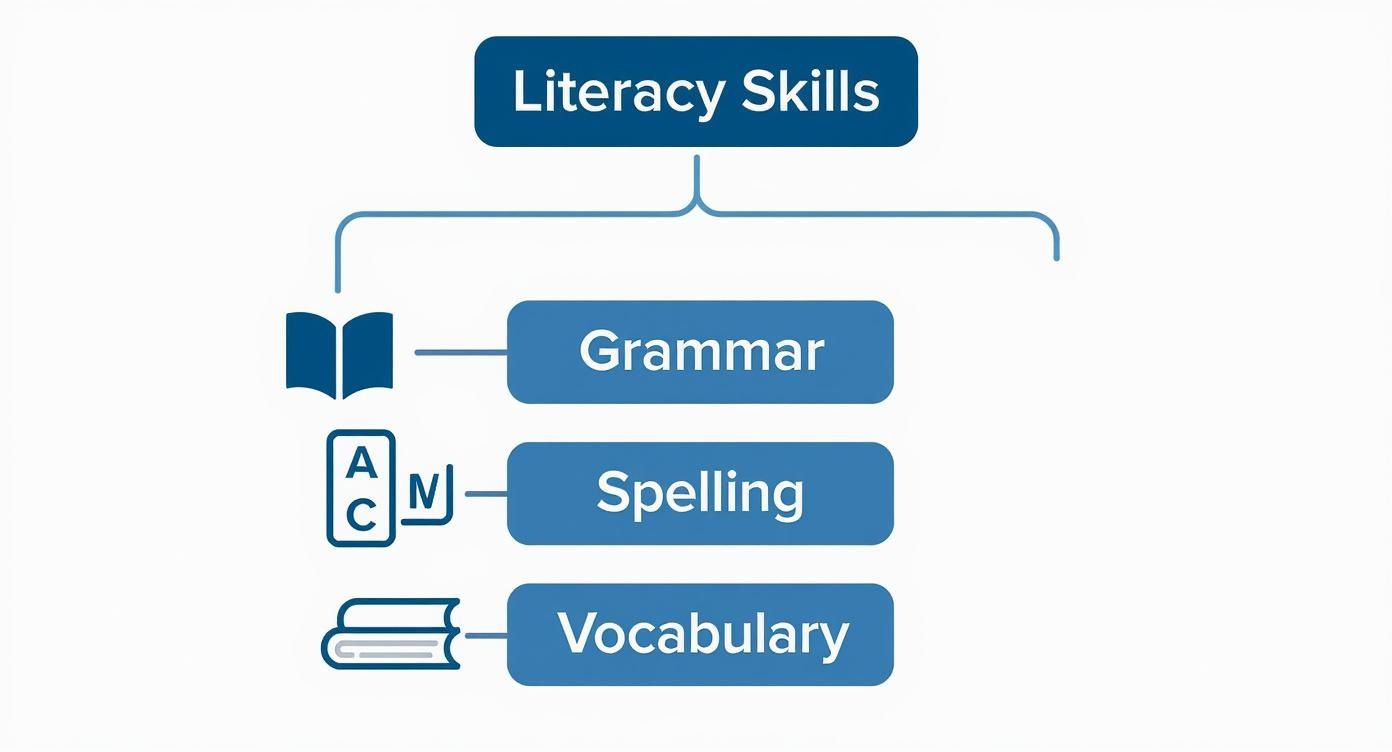
As you can see, core components like grammar, spelling, and vocabulary all stem from this single, powerful practice. It’s wonderfully efficient!
In these early years, our primary focus is on the perfect execution of individual letters and then, very short words. Lessons should be incredibly brief, often just five minutes long, to match a young child's attention span. Remember, the goal here is quality, not quantity.
Think of this stage like building with blocks. Before a child can construct an elaborate castle, they first have to learn how to handle each individual block. In the same way, a young writer needs to master the strokes that form each letter. Using a sand tray or a small whiteboard is a fantastic way to start, as it allows for large muscle movements and makes letter formation a physical, tactile experience before ever moving to pencil and paper.
For children in this age range, integrating copywork into a predictable daily rhythm is incredibly helpful. If you’re looking for ideas on structuring your day, you might find some inspiration in our guide to creating a homeschooling a preschooler schedule, which can easily be adapted for these early elementary students.
As children move into the middle grades, their fine motor skills and attention spans have developed quite a bit. Now, they are ready to transition from copying single words to transcribing whole sentences and even short paragraphs. This is where the real magic of absorbing grammar and style truly begins.
During this stage, the child also moves from copying a perfect handwriting font to transcribing from a standard typed font in a book. This requires them to hold a mental picture of a word or phrase before writing it down, which is a fantastic exercise for strengthening their working memory.
"Once he’s looking at and writing two words at a time, he’s ready for transcription. And he can continue transcription over the rest of his school years." – Sonya Shafer
Lessons can now comfortably extend to around 10 to 15 minutes. The source material becomes incredibly important; this is the perfect time to introduce them to beautiful poetry, Scripture verses, and memorable sentences from their literature readings.
For older students, copywork evolves into a much more analytical and personal practice. The focus shifts from the mechanics of handwriting to the art of the language itself. They are now ready to transcribe longer, more complex passages to really understand an author's style, voice, and use of literary devices.
This practice can become a personal treasury of beautiful language. I highly encourage you to have your teen keep a "commonplace book" or a special journal where they can collect passages that inspire or move them. This act of curating and transcribing meaningful texts fosters a deep and lasting appreciation for the written word.
To help you visualize this journey, here’s a simple table outlining how copywork can grow with your child.
| Age Group | Typical Passage Length | Daily Frequency | Primary Learning Focus |
|---|---|---|---|
| Ages 6–8 | 1 letter to 2-3 words | Daily (5 mins) | Perfect letter formation, spacing, careful habits |
| Ages 9–12 | 1 sentence to a short paragraph | Daily (10-15 mins) | Grammar, punctuation, spelling, sentence structure |
| Ages 13+ | A full paragraph or longer | 2-3 times per week | Author's style, vocabulary, literary devices |
This table serves as a general guide. Always remember to observe your own child and adjust as needed to keep the experience positive and fruitful.
By tailoring the copywork experience to each age group, you ensure it remains a living, breathing part of their education, one that nurtures both their skills and their souls.

The real heart of the copywork Charlotte Mason method isn't just the physical act of writing; it's the substance of what your child is writing. The quality of the material is everything. This is where a simple handwriting exercise is transformed into a profound lesson that shapes both the mind and the soul.
Instead of generic practice sentences, this beautiful method calls for living texts. These are passages that are rich in language, noble in their ideas, and full of life. When a child carefully copies a beautiful poem or a powerful piece of Scripture, they are doing so much more than practicing penmanship. They're meditating on truth and beauty, and those words begin to take root in their hearts.
Living texts are the antidote to the dry, lifeless material you find in so many traditional workbooks. Think of them as words written by passionate authors who present their subjects with clarity and style. It's the difference between a textbook definition of a flower and a poem by Christina Rossetti describing one. Both give information, but only one breathes life into the subject and captures the imagination.
By choosing these kinds of passages, you're offering your child a feast of great ideas. They will naturally absorb sophisticated vocabulary, elegant sentence structures, and a rhythm of language that just can't be taught through drills. This practice truly transforms their inner world and gives them a treasury of noble thoughts to draw upon for the rest of their lives.
The goal is to furnish a child’s mind with a storehouse of beautiful, inspiring, and thought provoking ideas. The words they copy become the intellectual and spiritual furniture of their minds.
This careful selection process ensures that every copywork lesson is also a lesson in literature, history, or faith. It makes for a wonderfully efficient and rich use of your homeschool time.
Finding the perfect passages can be one of the most delightful parts of your homeschool planning! You can seamlessly integrate copywork with your other subjects by pulling sentences from your history readings, science books, or daily read alouds. This approach beautifully reinforces what your child is already learning and brings a wonderful cohesion to your homeschool day.
Here are some excellent sources to draw from:
While curating a collection of excellent texts is important, don't underestimate the power of choice. Allowing your child to help select their copywork passages can dramatically increase their engagement and sense of ownership over their work.
When your child finds a sentence in a book that they think is particularly beautiful, funny, or interesting, encourage them to choose it for their copywork. This simple act validates their literary tastes and helps them develop an eye for quality writing. It turns the lesson from a simple assignment into a personal pursuit of beauty.
This little bit of collaboration makes the process more enjoyable for everyone and helps cultivate a lifelong habit of collecting and treasuring well crafted words. Ultimately, the goal is to make copywork charlotte mason a delightful journey, not just a destination of perfect handwriting.
You might wonder if a method from a century ago can really fit into our busy, modern lives. I’m here to tell you that the principles of Charlotte Mason copywork are not just surviving; they are thriving in today’s homeschools. This time tested practice has found a vibrant community of families who see its profound value in a fast paced world.
Families just like ours are discovering that this simple, focused activity brings incredible results. It serves as a gentle anchor in the homeschool day, a quiet moment set aside for beauty, truth, and precision. I hear from parents all the time who report significant improvements in their children's handwriting, grammar, and attention to detail.
The modern revival of copywork isn't just a niche practice; it's a widespread and successful tool for families who want a richer, more connected education. In fact, a recent survey of homeschooling families showed that about 35 to 40% of those following a classical or Charlotte Mason style actively use copywork in their daily curriculum.
These parents are finding that just five to ten minutes a day for younger students, right in line with Mason’s original advice, is all it takes. What's even more encouraging is that nearly 80% of them see better attention to detail and language comprehension after just six months of consistent practice. You can discover more about these inspiring copywork findings on joyfullydomestic.com.
Today's homeschoolers have wonderfully adapted this method, blending its classic principles with modern convenience. This fusion makes bringing copywork into your home easier and more engaging than ever before.
Many of us use beautifully designed printable resources or specialized notebooks that provide curated passages. This saves so much prep time while still offering the high quality, living texts we want for our children.
By integrating copywork across subjects, for example using a line from a history book or a definition from a science lesson, parents are reinforcing learning in a seamless and holistic way.
This clever integration shows just how flexible the practice is. It’s not an isolated subject to check off a list, but a tool that weaves through and enriches the entire educational experience.
The enduring popularity of copywork is powerful proof of its value. When you embrace this method, you’re not just adopting a school lesson; you are joining a large and supportive community of fellow educators. You're part of a movement that has rediscovered the deep and lasting benefits of this simple, beautiful, and effective practice.
Whenever you start something new in your homeschool, questions are bound to pop up. It’s completely normal! When it comes to the beautiful practice of copywork Charlotte Mason style, a few common concerns tend to surface.
Think of this as your friendly troubleshooting guide. These answers are grounded in the gentle, grace filled principles of the method and will help you keep your copywork lessons smooth and positive.
If you're facing resistance, it’s often a sign that a small adjustment is needed. Before you assume your child just dislikes copywork, take a step back and consider a few things. First, is the lesson too long? For a young child, even five minutes can feel like an eternity.
Next, look at the passage itself. A child is far more likely to copy something they find funny, beautiful, or exciting. Try letting them choose their own sentence from a favorite picture book. This little bit of ownership can completely transform their attitude toward the lesson.
While the goal is careful, beautiful work, our response to mistakes should always be gentle. In the Charlotte Mason method, we avoid erasers. Instead, if a child makes a mistake, simply ask them to draw a single, neat line through the word and write it correctly beside it.
This approach teaches children that mistakes aren't failures; they're just opportunities to make it right. It also keeps the page from looking messy and discouraging, which can be a big deal for a little learner.
The emphasis is on doing their best work, not on achieving flawlessness from day one. This gentle correction builds a habit of care without fostering a fear of failure.
For the youngest children just learning their letters in a sand tray or on a whiteboard, mistakes are even simpler to manage. A quick wipe gives them a fresh start, removing any sense of pressure and keeping the whole process feeling like play.
Patience, dear mama. Beautiful handwriting doesn't happen overnight. It develops slowly with consistent, short lessons. If your child’s handwriting is messy, it's almost always a signal to shorten the lesson. When a child feels rushed, their work will show it.
It is far better to have one perfectly formed word than a full sentence written in a hurry. You can help train their eye for quality by celebrating their best effort. Ask, "Which letter is your very best one today?" This simple question encourages them to take pride in their work and notice the details. Remember, progress with copywork charlotte mason is a slow and steady journey, not a race.
At Motherhood and Homemaking, we are here to support you in creating a beautiful, faith centered learning environment in your home. For more encouragement and practical resources, explore our guides and join our community.
Discover more at https://motherhoodandhomemaking.com.