Gentle Homeschool Curriculum for Kindergarten
A gentle, Christ centered homeschool curriculum for kindergarten is less about rigid academics and more…

Family devotional books are wonderful, practical tools designed to help you weave faith right into the fabric of your daily life. Through shared stories, thoughtful discussions, and prayer, these books do more than just fill a few minutes of your day. They help you build a strong spiritual foundation for your children, turning ordinary moments into powerful opportunities for connection and growth.

In a world humming with endless distractions, creating intentional moments to connect as a family is more essential than ever. Setting aside time for a family devotional offers a quiet space to pause, reflect, and reinforce the values you hold dear. It’s a chance to step away from the daily rush of school, chores, and activities to focus on what truly matters.
Try to think of a family devotional not as another task on your to-do list, but as an anchor for your day. It creates a consistent, predictable rhythm that provides comfort and a sense of security for your children. This simple practice helps you build a culture of open conversation where your kids feel safe asking those big questions about faith, life, and their place in the world.
The real power of devotional books for families is their ability to translate abstract spiritual concepts into tangible, kid-friendly lessons. They act as a bridge, connecting timeless biblical truths to the everyday challenges and triumphs your child experiences. This regular exposure to faith-based conversations does more than just teach; it shapes character and builds a moral compass that will guide them for years.
This shared spiritual practice also strengthens family bonds and nurtures a beautiful sense of unity. When you learn and grow together in faith, you’re creating a shared history that your children can draw upon for the rest of their lives. These moments become the building blocks for a resilient spiritual legacy. Our guide on fostering family stability explores how intentional routines like these contribute to a peaceful and connected home.
A consistent devotional routine is one of the most effective ways to disciple your children, showing them that faith is not just for Sundays but a vibrant, active part of everyday life.
Ultimately, family devotionals are about relationship—with God and with each other. They create a natural starting point for meaningful dialogue, and the benefits extend far beyond a single lesson.
By investing just a few minutes each day, you are planting seeds of faith that will have the chance to flourish for a lifetime.
What’s the difference between a book that gathers dust on the shelf and one that becomes a dog-eared, well-loved part of your family’s routine? A truly great family devotional does more than just retell Bible stories; it builds a bridge between God’s timeless truths and the very real world your child lives in. It’s all about genuine, heartfelt application.
And it seems more families than ever are looking for these kinds of resources. The global market for spiritual devotional products, which includes these family-focused books, was valued at over $4.1 billion in 2025. This just goes to show that parents everywhere are searching for meaningful ways to connect with their kids on a spiritual level. You can read more about the growth in the spiritual products market to see just how widespread this desire is.
When you know what to look for, you can see past a cute cover and choose a book that’s truly designed to connect with your family’s hearts.
Most of the best devotional books are built around a simple, repeatable pattern. This structure is a lifesaver for busy parents and helps kids know exactly what to expect, making it easier for them to engage day after day. A powerful devotional almost always includes four key elements that work together to create a memorable experience.
Think of these as the building blocks that ensure a lesson isn’t just heard, but is also understood, felt, and put into practice.
I like to think of these four parts like baking a cake. You need the flour (Scripture), the sugar (the relatable story), the eggs to bind it all together (discussion questions), and the baking powder to make it rise (the action step). If you leave one out, it just doesn’t turn out right!
This simple but intentional structure turns reading into a real conversation. It guides your family from a foundational truth to a practical, real-world application, making faith a living, breathing part of your daily rhythm. When you know how to spot this anatomy, you can confidently pick out devotional books for families that will truly nourish your children’s hearts and minds.
With so many wonderful devotional books for families out there, picking just one can feel a little overwhelming. But the secret isn’t finding the single “best” book—it’s about finding the best book for your family in this specific season of life. Let’s walk through a simple framework to help you confidently choose a resource that fits right into your family’s rhythm.
The first and most important thing to consider is your children’s age and developmental stage. A devotional that soars over a toddler’s head or feels too simplistic for a teen will quickly lose its impact. The goal is always to meet your children right where they are.
This simple visual can help you think through the core ingredients that make a devotional really connect with a family.
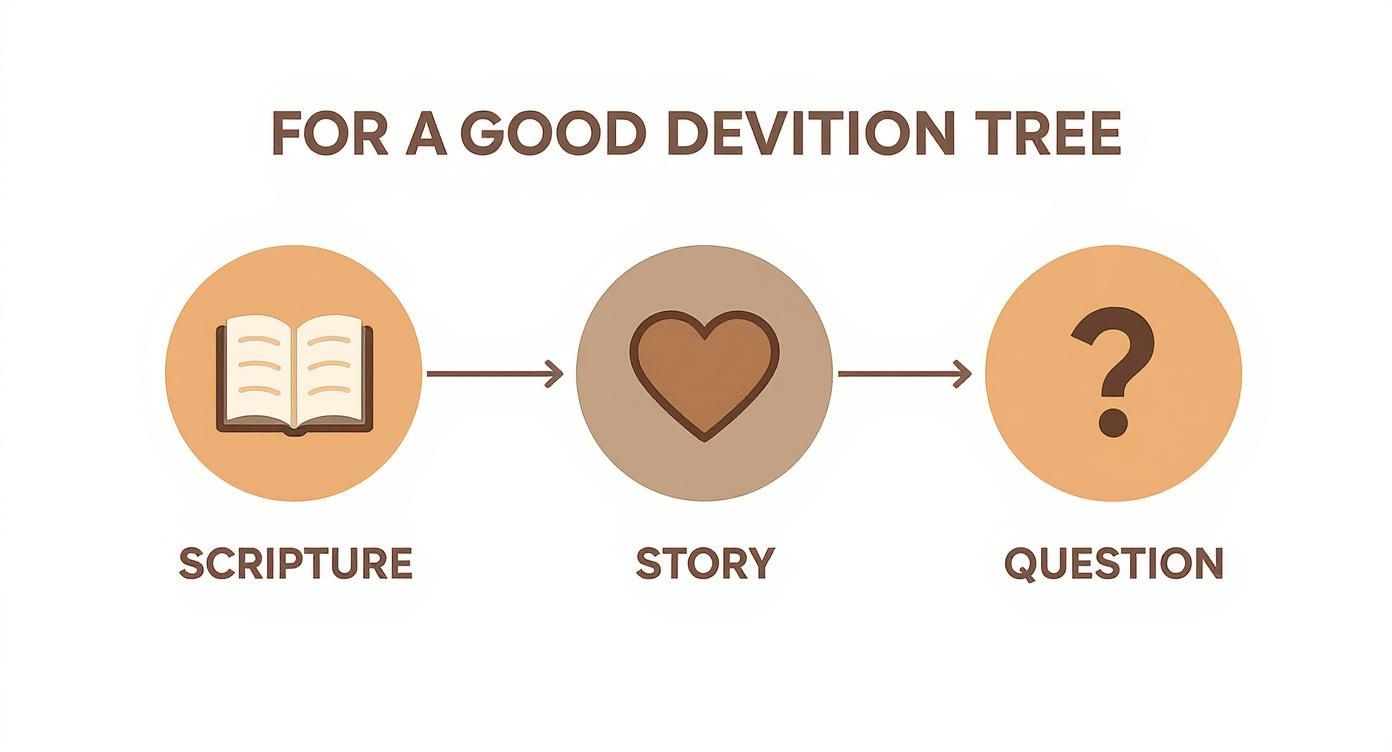
As you can see, the most effective devotionals usually blend Scripture, relatable stories, and thoughtful questions. This combination creates a rich, well-rounded experience that invites real conversation.
For the little ones—toddlers and preschoolers—your best bet is sturdy board books with vibrant illustrations. Look for ones that share a single, simple truth on each page, like “God loves you” or “God made the animals.” At this stage, it’s all about positive exposure and building a sweet, simple routine.
Once your kids hit those early elementary years (around ages 6-9), they’re ready for more complex stories. This is the perfect time to find books that pair a short Bible story with a modern-day example they can relate to, followed by one or two open-ended questions. These kinds of resources build a beautiful bridge between ancient biblical accounts and their own lives.
For pre-teens and teenagers, the focus naturally shifts toward real-life application and digging into deeper questions. Look for devotionals that tackle relevant topics like friendship, identity, peer pressure, and finding their purpose. A resource that encourages journaling or personal reflection can be especially powerful at this age.
A common mistake is choosing a devotional that’s too advanced, which can lead to frustration for both parents and kids. It’s always better to start simpler and build from there, ensuring the experience stays joyful and encouraging for everyone.
Beyond age, think about your family’s unique schedule. Are you looking for a quick, five-minute reading you can squeeze in before school, or do you have the space for a more in-depth weekly study on a Sunday afternoon? Neither one is better than the other; it’s all about what works for you.
Finally, consider the theological tone. You’ll want to make sure the devotional aligns with your family’s core beliefs and values. Some books are rooted in a specific denomination, while many others are broadly evangelical or non-denominational. Reading reviews and looking at sample pages can give you a good feel for the author’s perspective and help you ensure it’s a good fit for your home.
And while finding a great book for the whole family is the goal, sometimes moms need their own source of encouragement. For that, you might enjoy a resource created just for you, like the Mom with Grace Christian devotional.
Once you start looking for devotional books for families, you’ll quickly find they aren’t all the same. Most are built around powerful, foundational themes, like different pathways designed to help your children build a strong moral and spiritual compass. Knowing what they are helps you pick a book that speaks directly to what your family needs right now.
Many of the most cherished devotionals are all about bringing Bible stories to life. They retell the classic accounts of heroes like David, Esther, and Noah in a way that’s engaging and easy for young minds to connect with. This approach helps Scripture feel less like an ancient, dusty text and more like an exciting, living story full of real people who trusted God through incredible circumstances.
Another really popular and impactful category focuses on building character. These books take one core value at a time—like gratitude, honesty, courage, or compassion—and dive deep into it over several days or even weeks. It’s an incredibly effective way to help kids understand not just what a virtue is, but how to actually live it out at school, at home, and with their friends.
A devotional on gratitude, for example, might share stories about being thankful, include prompts to list three things they’re grateful for each day, and offer simple prayers of thanks. This method turns an abstract idea into a real, tangible daily practice, helping to shape your child’s heart and how they see the world.
Choosing a theme that addresses a current family challenge or growth area can be incredibly powerful. It allows you to parent proactively, using the devotional as a gentle guide for important conversations.
This focused approach is definitely resonating with families. In the U.S. Christian retail market, devotionals have seen incredible growth, now making up 17% of the entire adult book category. Retailers have also seen a specific rise in demand for devotionals that touch on mental and emotional health, showing just how much families want resources that connect faith to real-world wellness. You can find more insights on these trends in the 2025 State of Christian Retail report.
Finally, a growing number of devotionals are written specifically to help kids navigate the tough stuff with a foundation of faith. These books aren’t afraid to tackle important topics like:
These kinds of resources are invaluable. They help equip your children with the spiritual and emotional tools they need to face life’s complexities with confidence and grace.
By intentionally choosing a theme, you can transform your family devotional time from just another thing on the to-do list into a targeted, heart-shaping experience that meets your kids exactly where they are.

Here’s the thing: the best devotional is the one your family actually uses. The goal isn’t a perfect, hour-long Bible study. It’s about creating small, sustainable pockets of connection in your daily rhythm. Success is measured by consistency, not how long you spend; even five focused minutes together can be incredibly powerful.
This whole practice feels so much more doable when you weave it into routines you already have. Instead of trying to carve out a new time slot in an already packed schedule, just attach devotional time to something you do every single day. It removes the friction of starting something new and helps the habit stick.
It’s clear that families are looking for these resources. In the UK, Bible and devotional sales recently grew by almost 14% in just six months. Here in the U.S., sales climbed 11%, showing that families are really prioritizing materials that support their faith at home.
Finding the right moment is what transforms a devotional from a chore into a cherished family tradition. The best time is simply when your family is already gathered and relatively calm.
Here are a few ideas that have worked for us and other families:
Remember, the aim is to build a joyful habit, not a rigid obligation. If you miss a day, just pick it back up the next. Grace is the most important ingredient here.
It’s completely normal to face a few challenges, especially when you’re dealing with different ages and attention spans. Knowing these bumps might be on the road helps you navigate them with patience and a little creativity.
If you have little ones, keep it short. A few minutes is perfect. Let them hold the book, act out the story, or draw a picture of what you talked about. For older kids or teens who might seem a bit resistant, give them some ownership in the process. Let them choose the devotional book, lead the discussion, or pick the topic for the week.
When the routine feels authentic and flexible, it’s so much more likely to become a beloved part of your family culture. For more ideas on establishing positive daily rhythms, you can explore our guide to creating a peaceful Christian morning routine.
Jumping into the world of devotional books for families feels exciting, but it almost always brings up a few questions. That’s perfectly normal! I want to walk through some of the most common concerns I hear from parents, hopefully bringing you some confidence and peace of mind as you start this beautiful journey.
Think of these questions not as roadblocks, but as little signposts guiding you toward a rhythm that truly fits your unique family. Getting these answers upfront helps clear away any hesitation, freeing you up to focus on the joy of connecting with your kids.
Honestly, it’s never too early or too late to begin. The real key is matching the book and the approach to your child’s developmental stage. You want the experience to feel engaging and positive, not frustrating.
For the little ones (ages 2-4), think simple and hands-on. Board books with one core truth per page—like “God loves you”—are just right. Their attention spans are tiny, so the goal is simply positive exposure and building a routine, not deep theological understanding.
As children hop into their preschool years (ages 4-6), they can handle a bit more. Look for devotionals with short, engaging stories, a simple follow-up question, and maybe even a song or a rhyme to go along with it. Repetition is their best friend at this age!
Early elementary kids (ages 6-9) are ready for that classic devotional structure. They can follow along with a scripture passage, connect it to a relatable story, and talk through a few thoughtful questions. This is where you can really start building those crucial bridges between faith and their everyday lives at school and with friends.
Engagement is everything when you want your devotional time to stick. The secret is to keep your sessions short, predictable, and, most importantly, interactive. Boredom usually creeps in when kids feel like they’re just being lectured to.
A devotional isn’t a sermon; it’s a conversation. The moment you shift your mindset from teaching a lesson to starting a dialogue, you’ll find your kids naturally become more engaged.
To make it more of a conversation, try these simple ideas:
This can be a wonderful opportunity to model unity, respect, and open-mindedness for your children. The focus should be on finding common ground. I’d suggest starting by sitting down together and identifying the core values you both want to instill in your kids, such as kindness, honesty, courage, and empathy.
From there, you can choose devotionals that center on these universal character themes from a broad faith perspective, rather than focusing on specific or divisive doctrines. Many excellent resources are non-denominational and welcome families from all sorts of backgrounds. During your devotional time, you can read a story together and then each share what it means to you from your own perspective. This approach teaches children that faith is a personal journey and that people can connect deeply on shared values even if their specific beliefs differ.
There’s no single “right” answer here—the best choice truly depends on your family’s unique lifestyle and what you prefer. Each format has its own distinct advantages.
Physical books are fantastic for creating a focused, screen-free moment, which is especially valuable for a calming bedtime routine. There’s something special about the tangible nature of a book, and turning the pages together is a sweet bonding experience.
On the other hand, digital devotionals and apps are incredibly convenient, especially for travel or busy on-the-go schedules. They often include engaging extras like animated videos, audio narration, or interactive quizzes that can really appeal to tech-savvy kids. You could even use a hybrid approach—enjoying a physical book for your main at-home routine and a digital app for car rides or vacations.
At Motherhood and Homemaking, we believe in equipping you with grace-filled resources to build a Christ-centered home. Explore our collection of articles and ebooks designed to bring peace and purpose to your family rhythms. Discover more at https://motherhoodandhomemaking.com.