Gentle Homeschool Curriculum for Kindergarten
A gentle, Christ centered homeschool curriculum for kindergarten is less about rigid academics and more…
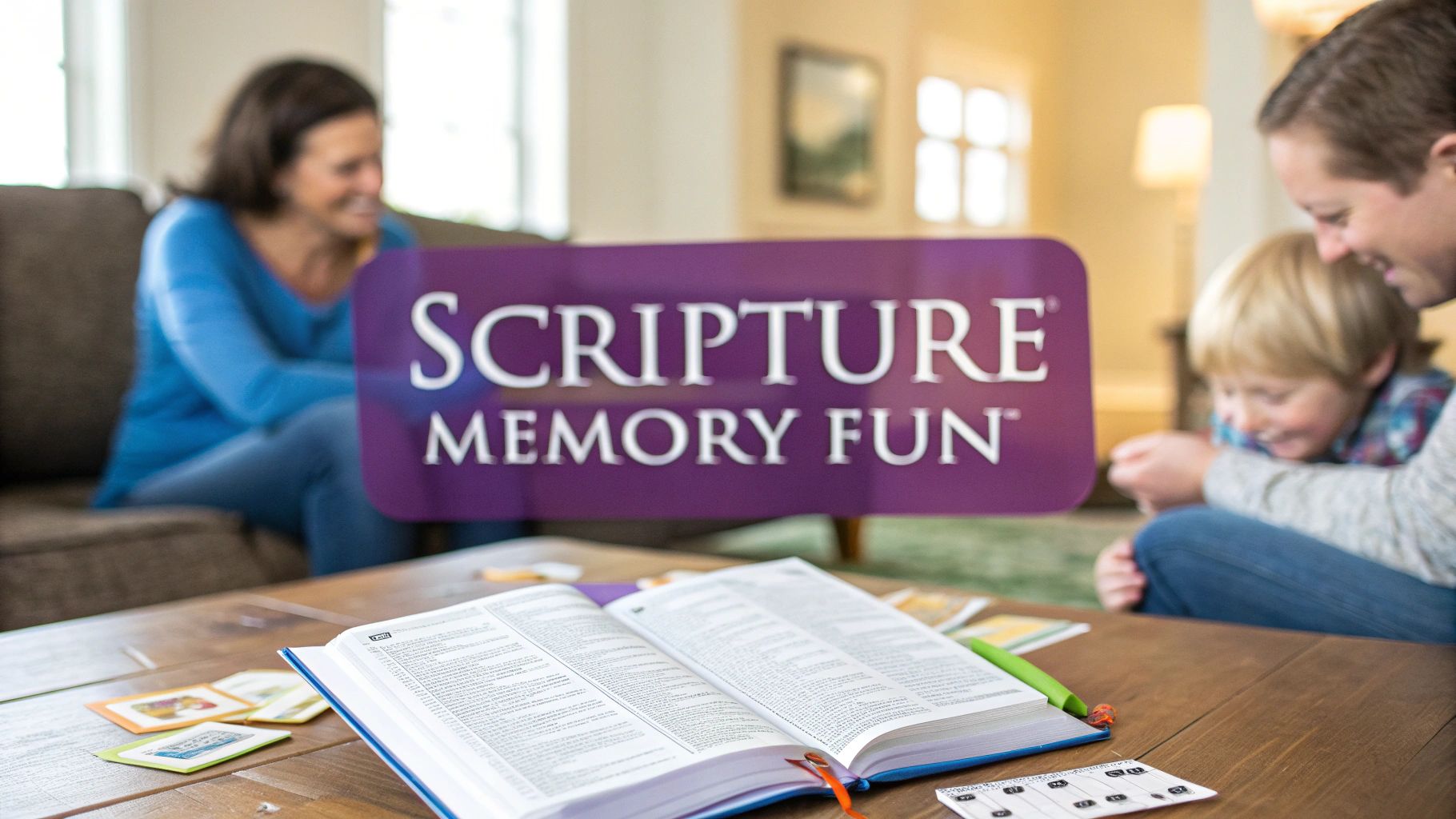
Welcome to a more joyful way to hide God's Word in your family's hearts. Memorizing scripture does not have to feel like a chore or a mundane task relegated to flashcards and repetition. Instead, it can be a vibrant, laughter filled part of your daily routine, creating cherished memories while building a lasting spiritual foundation.
By transforming this spiritual discipline into a game, we invite our children to engage with the Bible in a way that is both meaningful and incredibly fun. This playful approach helps build a strong foundation of faith rooted in the living Word of God, making His truths accessible and memorable for even the youngest learners. When we use scripture memory games, we are not just teaching verses; we are fostering a love for God's Word that can last a lifetime.
This article explores a comprehensive collection of creative and engaging scripture memory games specifically designed for busy families and homeschoolers. We will show you how to turn memorization into connection and quality time. Forget tedious drills and rote learning. Get ready to play, learn, and grow together in faith with practical, step by step instructions for each activity.
Here is a brief look at the games we will cover:
Scripture memory card games transform the classic flashcard into an exciting, hands on activity perfect for kinesthetic and visual learners. This method involves writing Bible verses, or parts of verses, on individual cards and using them in various game formats. The goal is to make repetition engaging, helping God's Word move from the page into your child's heart through play.
This approach is incredibly versatile, making it one of the most popular scripture memory games for families. By matching, sorting, or sequencing cards, children interact with the words physically, which significantly boosts retention. It’s an ideal starting point for families new to scripture memory because it’s simple to set up and easily adapted for different ages and learning styles.
Getting started is easy. You can purchase professionally made sets, like the Bible Verse Memory Cards from David C. Cook, or create your own for a personalized touch.
Pro Tip: Laminate your homemade cards. This small step makes them durable enough to withstand frequent use, spills, and the enthusiastic hands of young children, protecting your investment of time.
You can easily adjust the complexity for different age groups.
Scripture verse scavenger hunts turn memorization into an active adventure, perfect for energetic learners who thrive on movement and discovery. This method involves hiding Bible verse clues, references, or puzzle pieces around a designated area, leading participants on a physical quest. The goal is to connect scripture with action, making the process of finding and reading verses an exciting and memorable experience.
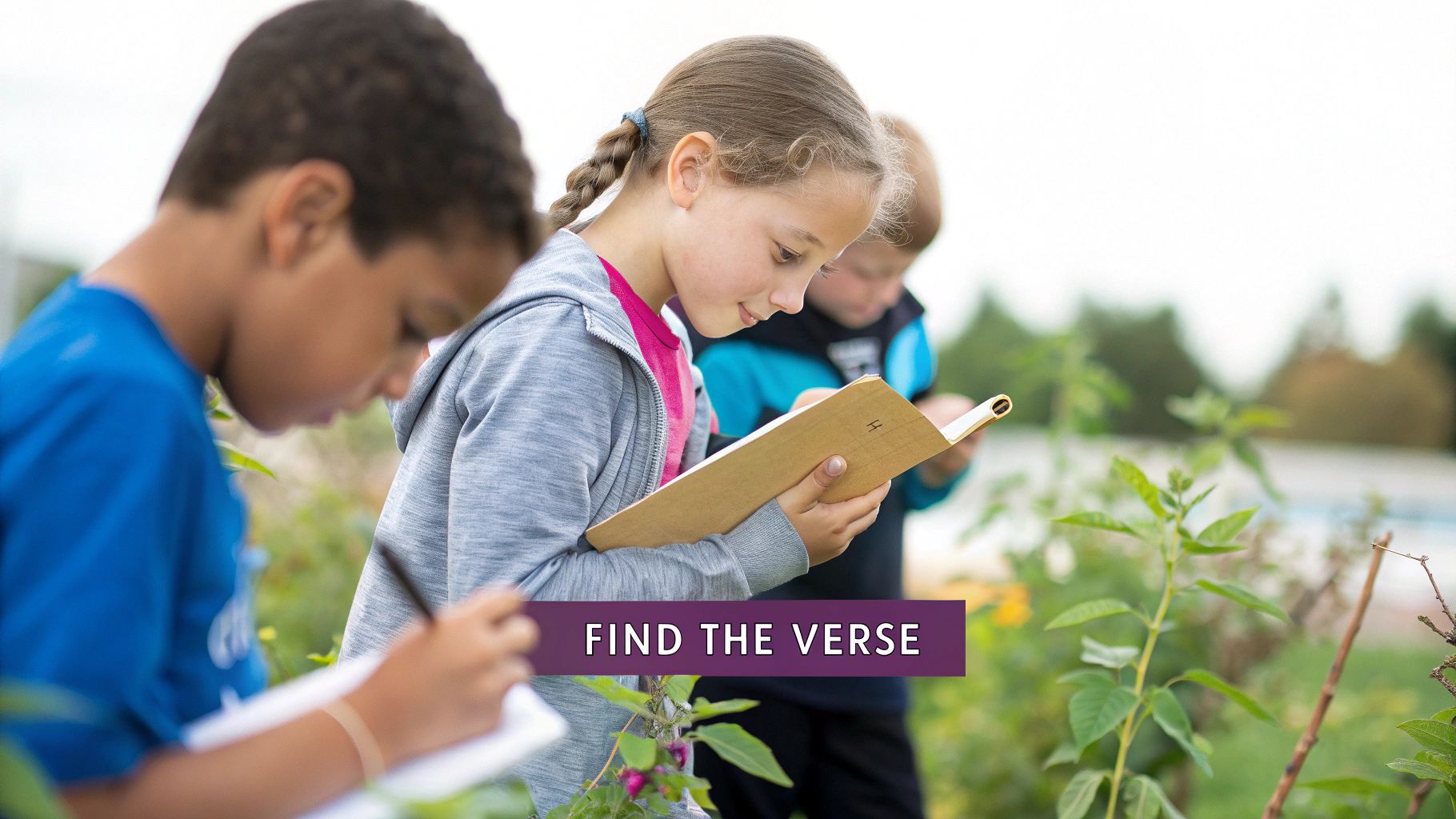
This gamified approach is highly engaging and one of the most dynamic scripture memory games for groups. By combining problem solving with physical activity, it helps children burn off energy while internalizing God’s Word. It is especially effective for church groups, family gatherings, or homeschool co ops, as it promotes teamwork and collaborative learning in a fun, hands on environment.
Setting up a scavenger hunt is creative and adaptable. You can make it as simple or complex as you like, tailoring it to your space and participants.
Pro Tip: Always do a complete walkthrough of the hunt yourself before starting. This helps you identify any confusing clues, unsafe locations, or logistical issues, ensuring a smooth and enjoyable experience for everyone.
You can easily scale the difficulty to suit different age levels, ensuring everyone feels challenged but not overwhelmed.
Bible verse trivia and quiz games introduce a thrilling element of competition that can ignite a passion for scripture memory, especially in older children and teens. This method tests knowledge through question and answer formats, moving beyond simple recitation to challenge factual recall and contextual understanding. The goal is to motivate learners to study verses more deeply so they can confidently answer questions and succeed in the game.
This approach taps into a natural desire for friendly competition, making it one of the most effective scripture memory games for groups. By framing memory work as a challenge or a team sport, you can engage those who thrive on goals and achievement. It is a fantastic tool for youth groups, homeschool co-ops, or family game nights, turning Bible study into a lively and memorable event.
Setting up a trivia game can be as simple as a verbal quiz or as high tech as a digital competition. You can use established platforms or create your own games from scratch.
Pro Tip: Incorporate an “explain your answer” component. Award bonus points not just for getting the answer right, but for explaining the verse’s meaning in their own words. This shifts the focus from pure memorization to true comprehension.
You can easily scale the difficulty of your trivia game to suit any age.
Scripture memory apps and digital games harness the power of technology to make memorizing God's Word an interactive and rewarding experience. This modern method uses gamification principles like points, levels, and achievement badges to motivate learners. These apps often incorporate proven learning techniques, such as spaced repetition, to optimize retention and make memorization more efficient.
This approach is perfect for today’s digitally native children and busy families. By turning memorization into a game on a phone or tablet, these tools can capture a child’s attention and make practice feel like play. These digital scripture memory games are a fantastic way to utilize screen time for a faith building purpose, providing a structured and engaging path to hiding Scripture in your heart.
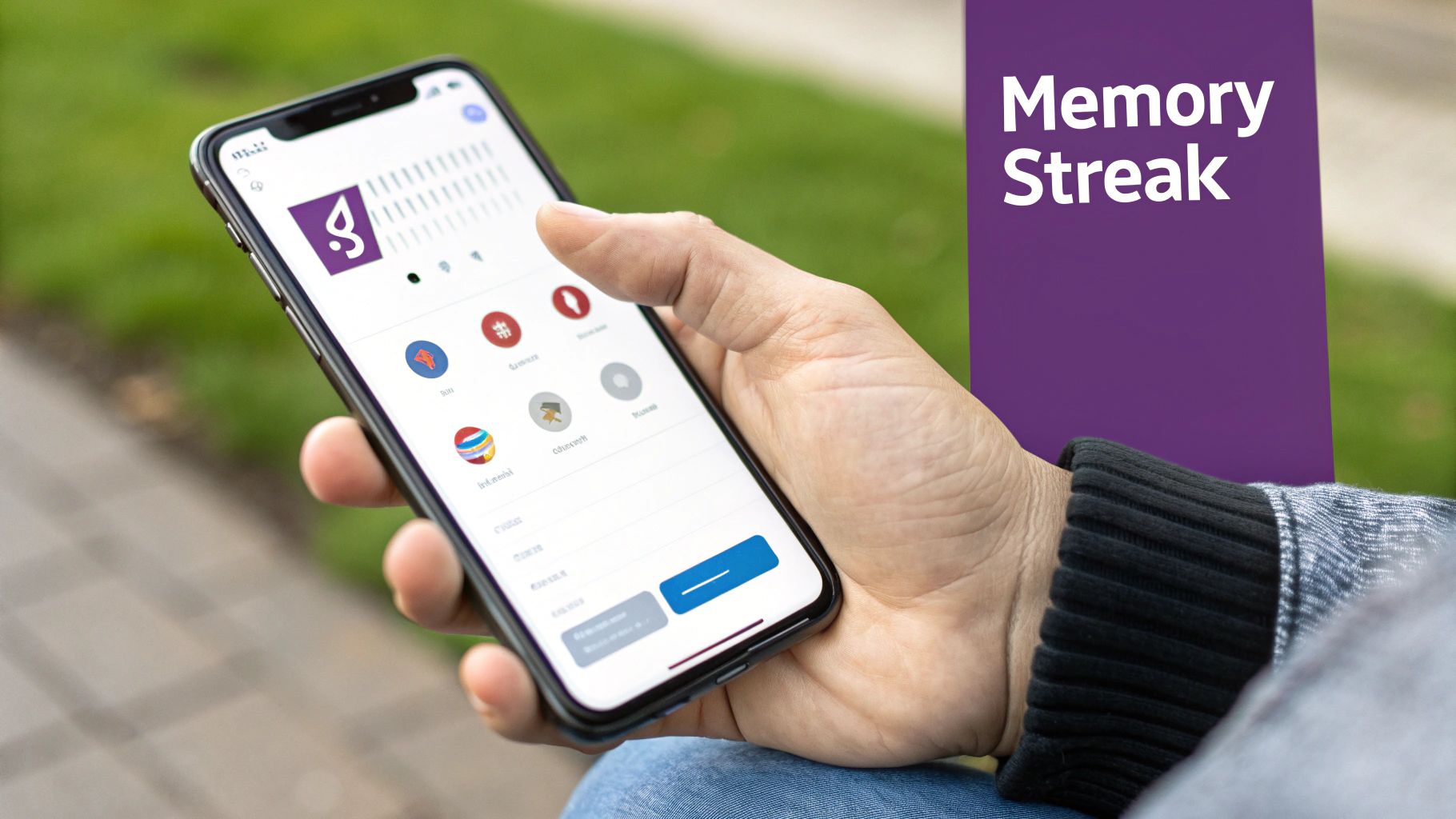
Getting started is as simple as downloading an app from your device's app store. Many apps are free or offer a free trial, allowing you to explore which one best fits your family's needs.
Pro Tip: Set up daily notifications within the app. A gentle reminder at the same time each day helps build a consistent habit of engaging with Scripture, transforming a small daily action into a powerful spiritual discipline.
Digital tools offer great flexibility for tailoring the experience to different developmental stages.
Verse mapping and puzzle games connect the analytical joy of problem solving with the spiritual discipline of Bible study. This method uses word searches, crossword puzzles, and jigsaws built around scripture passages. Children engage their critical thinking skills as they look up verses, understand context, and use their biblical knowledge to find solutions.
This approach is fantastic for older children who enjoy a mental challenge and for families looking to add more depth to their scripture memory games. Instead of simple repetition, these games require kids to examine the words, their meanings, and their placement within a verse. This analytical process creates strong neural pathways, embedding the scripture more deeply and fostering a greater understanding of its context.
You can find many premade resources or easily create your own customized puzzles to align with your current Bible lessons or memory verses. The goal is to make scripture discovery an adventure.
Pro Tip: Combine puzzle making with creative expression. After solving a puzzle, have your child draw a picture illustrating the verse. This artistic step helps solidify the verse’s meaning in a different part of their brain.
Adjust the puzzle's difficulty to match the child's developmental stage, ensuring it remains a fun challenge rather than a frustration.
Role playing and drama based scripture games bring the Bible to life by inviting participants to act out biblical stories and scenarios. This embodied learning approach moves beyond simple repetition by having children and adults incorporate memorized verses directly into dialogue and action. Players adopt roles, improvise scenes, and deliver scripture lines in context, connecting the words to emotions and events.
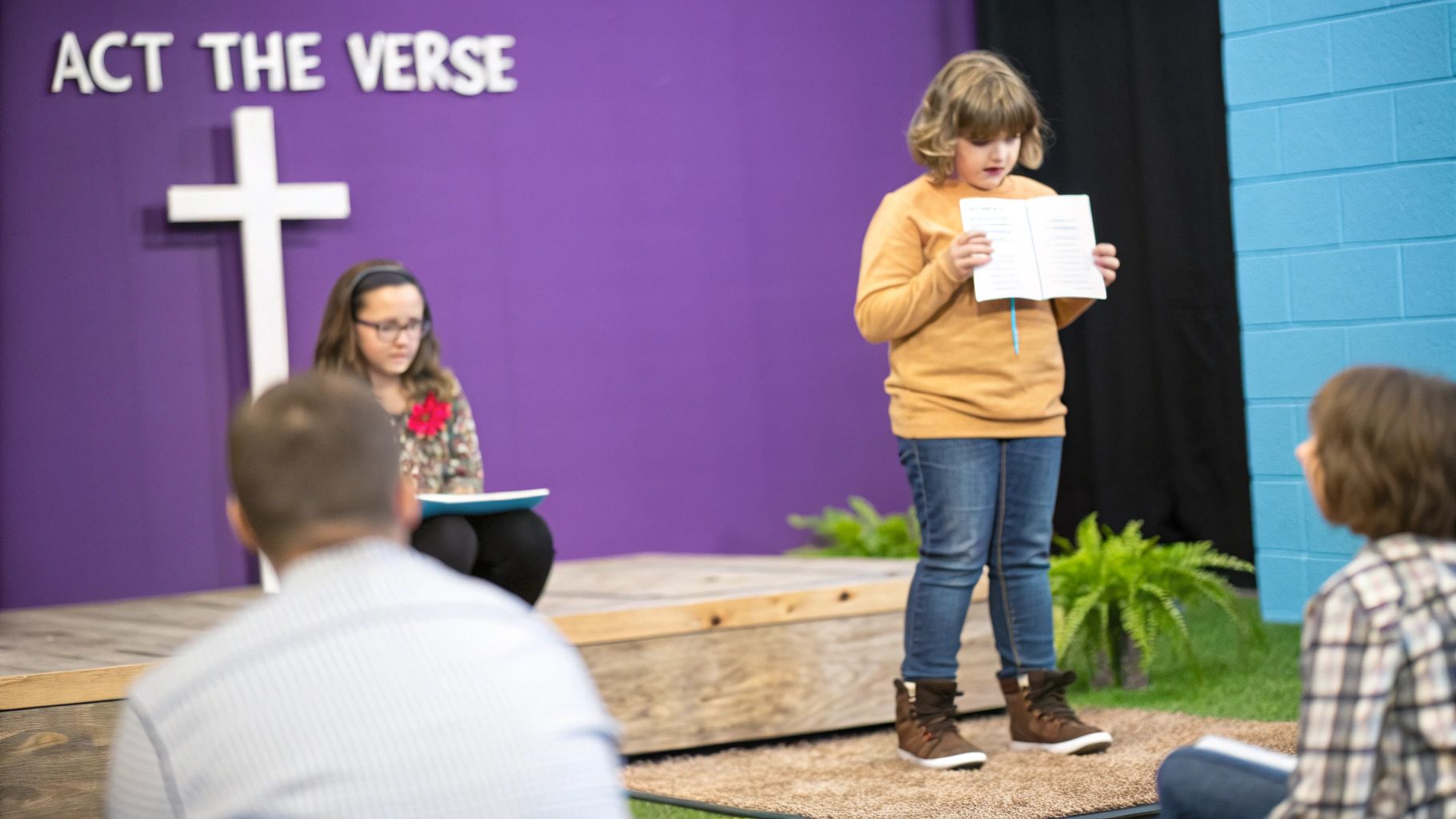
This method is one of the most powerful scripture memory games for kinesthetic and auditory learners because it engages the whole person. By physically performing the narrative, the verses become anchored to movement and experience, leading to deeper understanding and long term retention. It is perfect for group settings like Sunday school, youth group, or family nights, transforming scripture memory into a collaborative and unforgettable theatrical event.
You can start with simple charades or full scale productions. The key is to make it interactive and fun. You can find inspiration from church pageants or Christian theater productions.
Pro Tip: Film the performances on a smartphone. Watching the playback not only serves as a fun review but also helps children see their progress and builds their confidence in speaking God’s Word.
Adjust the complexity of the roles and verses to suit different age levels.
Scripture Memory Relay and Active Games infuse Bible memorization with high energy physical movement, creating an unforgettable learning experience. This method turns recitation into a dynamic team sport, perfect for kids who learn best when they are on their feet. The core idea is to link progress in a physical challenge, like a relay race or an obstacle course, to the correct recitation of a Bible verse.
This approach is exceptionally effective for groups, such as in Sunday school, youth groups, or large homeschooling families. It channels children's natural energy into a productive and spiritually enriching activity. By combining gross motor skills with cognitive recall, these scripture memory games help anchor God's Word in both mind and body, making retention remarkably strong.
Setting up a scripture relay is simpler than it sounds and can be adapted to any space, indoors or out. The key is to create stations or tasks that require both movement and memory.
Pro Tip: For fairness and encouragement, practice the verse together as a group several times before starting any competitive race. The goal is successful recall and fun, not just speed.
You can easily scale the physical and memory challenges for different ages.
Story based and narrative scripture games embed Bible verses within their original context, transforming memorization into an epic adventure. Instead of learning verses in isolation, this method connects them to the rich biblical stories they come from, making them more meaningful and memorable for auditory and imaginative learners. The goal is to progress through a storyline by reciting verses or solving puzzles related to the narrative.
This approach is highly effective because it provides a framework for understanding. When a verse is tied to a character’s struggle, a moment of triumph, or a divine promise, it gains emotional weight and purpose. These types of scripture memory games are perfect for helping children see the Bible not just as a book of rules, but as a grand, unfolding story of God’s relationship with His people.
You can use existing board games or easily create your own narrative journey. The key is to make the story the central part of the experience.
Pro Tip: Use dramatic voices and simple props to bring the stories to life. A blanket can be a shepherd’s robe, and building blocks can become the walls of Jericho. This sensory engagement makes the narrative and its associated verses unforgettable.
Adjust the story’s complexity and verse length to match your child’s developmental stage.
| Item | Implementation Complexity | Resource Requirements | Expected Outcomes | Ideal Use Cases | Key Advantages |
|---|---|---|---|---|---|
| Scripture Memory Card Games | Low, simple setup and rules | Low, printable/index cards, optional laminating | Improved verse recall; adjustable difficulty | Small groups, families, classrooms, individual practice | Low cost, highly customizable, tactile engagement |
| Scripture Verse Scavenger Hunts | Medium to High, clue design and layout planning | Medium, space, printed clues/QRs, supervision, weather contingency | High engagement, experiential retention, teamwork | VBS, youth events, camps, large group activities | Kinesthetic, memorable, scalable for groups |
| Bible Verse Trivia and Quiz Games | Medium, question creation and scoring setup | Low to Medium, devices/platform or paper quizzes, moderator | Measurable factual recall, competitive motivation | Large groups, classrooms, competitive learners, youth nights | Fast paced, easy scoring, tracks progress digitally |
| Scripture Memory Apps and Digital Games | Medium, app setup and content customization | Medium to High, smartphones/tablets, internet, possible subscriptions | Optimized long term retention via spaced repetition; automated tracking | Individual learners, remote participants, tech savvy users | Spaced repetition, analytics, portability, notifications |
| Verse Mapping and Puzzle Games | Low to Medium, puzzle creation and validation | Low, printable/digital puzzles, pens or devices | Improved Bible search skills, concentration, visual learning | Independent learners, classrooms, quiet extension activities | Self paced, good for visual spatial learners, low cost |
| Role-Playing and Drama-Based Scripture Games | High, scriptwriting, casting, rehearsal required | Medium to High, space, props/costumes, rehearsal time, facilitators | Deep contextual understanding, memorable embodied learning | Youth groups, church performances, creative learners | Emotional engagement, community building, multi modal learning |
| Scripture Memory Relay and Active Games | Medium, station design and rules coordination | Medium, open space, equipment, multiple supervisors | High energy engagement, kinesthetic retention, teamwork | Large active groups, outdoor events, camps, picnics | Combines physical activity with memorization; highly engaging |
| Story-Based and Narrative Scripture Games | High, narrative integration and game design | Medium to High, materials, longer sessions, possible production costs | Strong contextual comprehension and meaningful connections | Bible study groups, families, educational programs, all ages | Context rich memorization, deeper understanding and retention |
We have explored a rich collection of scripture memory games, from the tactile fun of Scripture Memory Card Games to the energetic excitement of Verse Relay Races. Each activity, whether a tech savvy digital app or a creative drama based game, offers a unique pathway to hide God’s Word in the hearts of your children. The goal is not merely to check a box off your homeschooling to do list, but to cultivate a genuine, lifelong love for the Bible.
The journey of embedding Scripture into your family’s rhythm is one of joy, not a chore. By transforming memorization into a game, you dismantle potential resistance and build positive associations with learning God’s truth. Remember, the true victory is not perfect recitation, but a heart that is being softly shaped and guided by the principles within the verses you learn together. These shared moments of laughter, teamwork, and discovery become the very fabric of a faith filled childhood.
Reflecting on the variety of games covered, from Verse Mapping puzzles to Bible Trivia, several core principles emerge as vital for success. These are the foundational ideas that will help you transform these activities from a one time event into a sustainable family habit.
The most beautiful thing about weaving Scripture into your home is that you are not just teaching your children how to memorize. You are teaching them how to live, how to find comfort, and how to seek wisdom from the most important book they will ever read.
Feeling inspired but not sure where to begin? Don't let the number of options overwhelm you. The best approach is to start small and build momentum.
By embracing these playful, intentional methods, you are doing so much more than teaching verses. You are building a family culture where God’s Word is seen as a source of joy, guidance, and life. You are equipping your children with unshakable truths that will anchor them through every storm and celebrate with them in every triumph. These games are the seeds, and with love and consistency, you will cultivate a beautiful garden of faith that will flourish for generations to come.
For more resources on integrating faith into your daily routines and creating a Christ centered home, explore the articles and guides at Motherhood and Homemaking. Our mission is to equip you with the practical tools and gentle encouragement you need to raise your family with purpose and joy. Discover more at Motherhood and Homemaking.